
BIOGRAPHY
RUNNING FOR THE HUMAN RACE
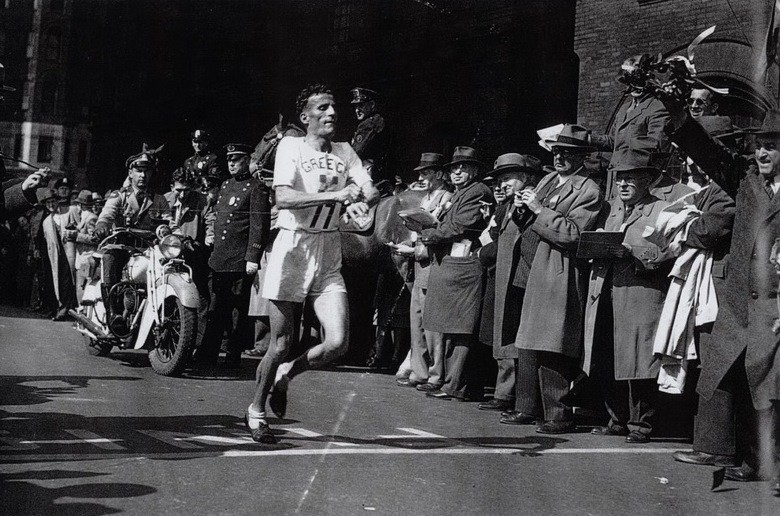
Boston 1946
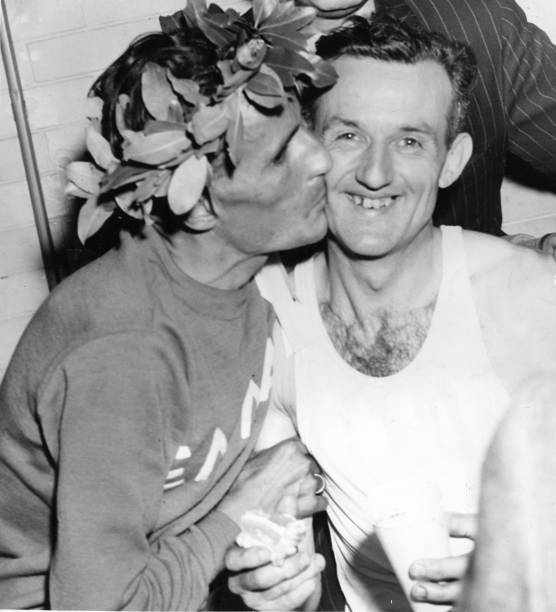
Crossing the finish line. Greek-American George Demeter (Massachusetts lawmaker) holds the laurel wreath. Wearing bib 77, his time was 2h 29m 27s, the best time in the world that year and the European record. Kyriakides died at the age of 77 in 1987. So 7 was the number dominating his life! Note the stopwatch on his wrist. Kyriakides was the first long-distance runner to use wrist stop-watch to pace himself.
Beginnings
Stylianos Kyriakides was born in the mountain village of Statos, near Pafos, in Cyprus in 1910. The youngest of five children, he left home for the city of Limassol at the age of 14, to find work and help his poor farming family. Following various jobs, he ended up as a ‘house boy’ for Dr Cheverton, The British Medical Officer. A marathon runner -himself, Cheverton encouraged the now 22-year-old Kyriakides to start running, gave him his first running gear, and coaching advice, and taught him to speak English.
Athletic achievements
.1932
Starts training for first time. At the Pan-Cyprian games, wins the 1,500, 5K, 10K and 20K.
.1932 – 1948
Greek champion 12 times: 5K (1934, 1936, 1937, 1938); 10K (1934, 1936, 1937, 1938); and marathon (1933, 1934, 1936, 1934). Best times: 5K, 15m 33s (1937); 32m 28s for the 10K (1936); marathon, 2h 29m 27s (1946)
.1934 – 1940
Balkan champion 10 times: 10K (1934, 1936); and marathon (1934, 1936, 1937 1939, second in 1933, 1938, 1939 and third in 1940).
Marathon champion: Hungary, Czechoslovakia, Egypt, Turkey, Yugoslavia, Romania and Bulgaria.
.1935 and 1937
Silver medalist in the English marathon at the AAA championship
.1936
11th place in the marathon at the Berlin Olympics (2h 43m 20s).
.1938
Boston marathon. While in the leading group, using his new and ‘unbroken’ shoes, without socks on the hard cement road surface, he developed severe blisters and dropped out in 21-mile
.1940 – 1945
WWII interrupted his athletic career. He does not train or run at all for 5 years.
.December 1945
Undernourished and extremely thin, he decides to start training to run the Boston Marathon. His idea is to go to the USA to publicize the plight of the Greek nation and its people after WWII and in the middle of the civil war. He goes to Cyprus for better training conditions, corresponding with his coach Otto Simitchek.
.1946
Crossing the finish line in Boston 1946 he shouts FOR GREECE. Wearing bib 77, his time was 2h 29m 27s, the best time in the world that year and the European record.
.1946
European games Oslo, Norway, marathon. Drops out because of severe cramps on his legs.
.1947
He goes to Boston, at the age of 36, in order to request financial and equipment assistance so that Greece can patripate in the the 1948 Olympic Games in London. He finishes in 10th place. From that year on Boston Marathon opened to foreign runners. The winner is a young Korean.
.1948
London Olympics, he finished in 18th place in the marathon (2h 49m 00s). A dramatic marathon. Many runners drop out because of excessive heat and very high humidity. Only 30 runners out of 41 that started, finish. The dehydrated Belgian leader is passed by two runners after entering the White City stadium.
.1949
After 16 years, five of which were interrupted by war, Kyriakides ends his athletic carrier at the age of 38.
.1951
Kyriakides is elected to join the Greek Athletic Federation (SEGAS). From 1955 until 1981, he was responsible for organizing the Athens International Marathon, where the best runners in the world participated, including Abebe Bekila in 1962, the Fin Veiko Karvonen in 1955, and Ron Hill and Bill Adcoks in 1969).
STYLIANOS KYRIAKIDES
HIGHLIGHTS
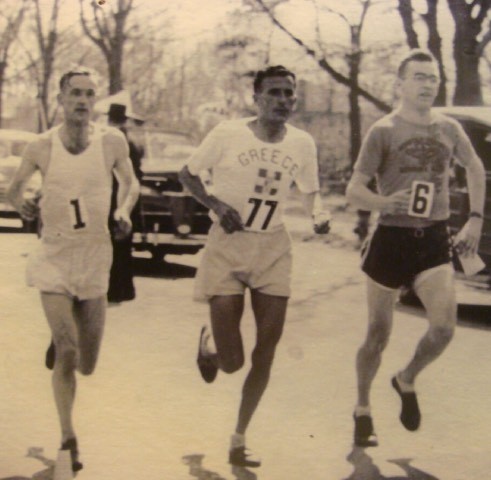
Crossing the finish line in Boston 1946
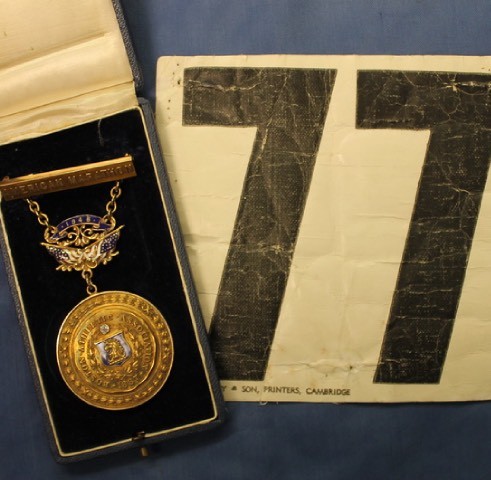
1946 - Boston medal and bib
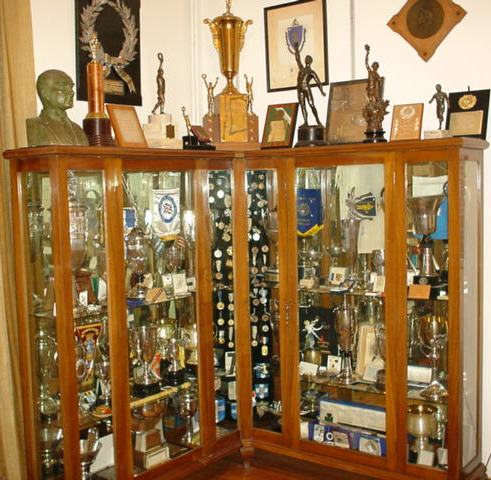
1950 SK cups and medals
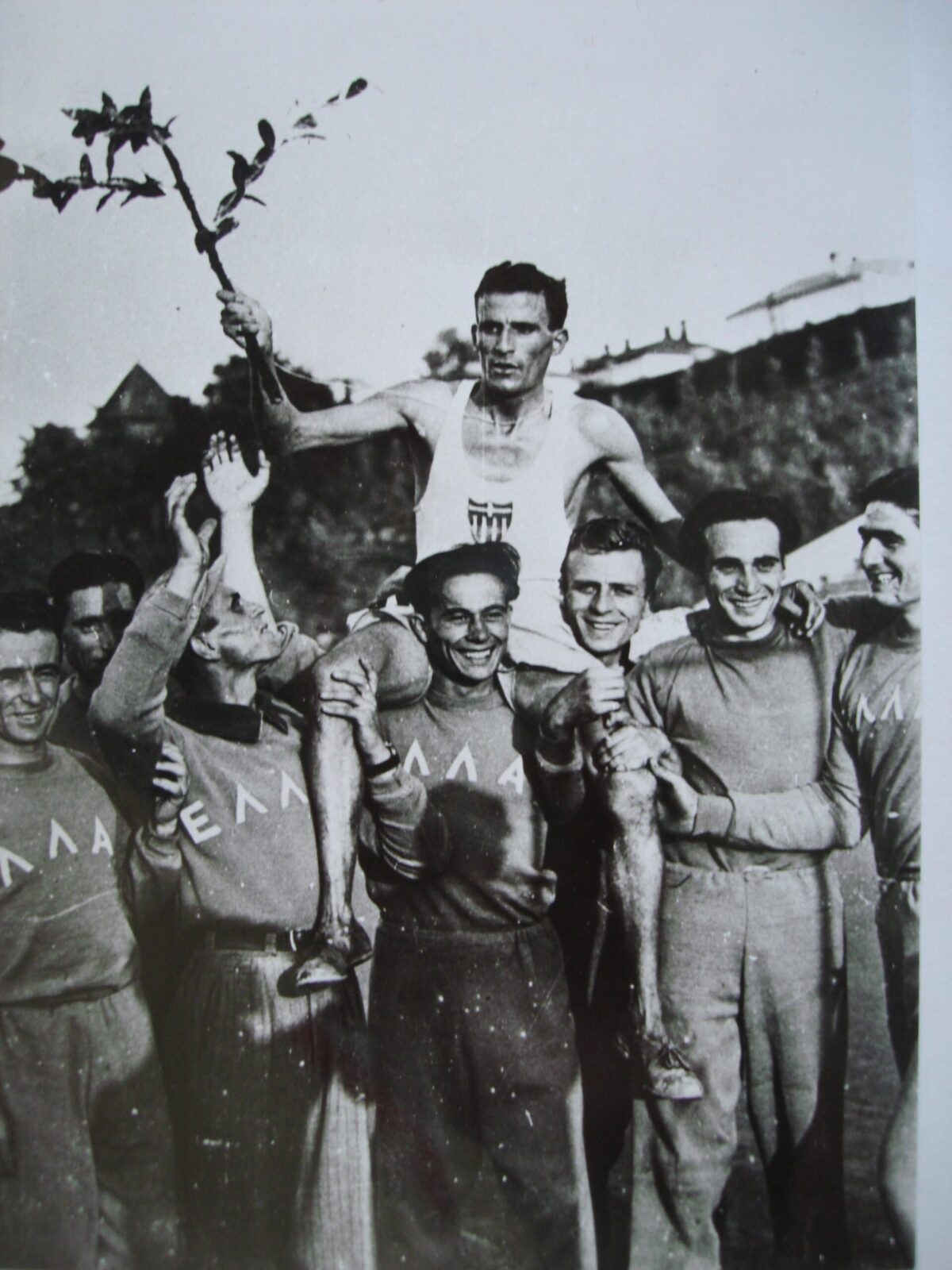
The Runner
At his first Pan-Cyprian games in 1932, Kyriakides won both the 1,500 and 10,000 meters on Friday, followed by the 5,000 and 20,000 meters on Saturday and Sunday. Hailed as a great talent, he was asked to run in the national championships in Greece, where he came first in the marathon and second in the 10,000 meters.
He subsequently trained under the great Hungarian coach Otto Simitchek, who had been brought to Greece in 1929 to revive the Greek national track and field team. Simitchek created the ‘Greek Dream Team’ of the 1930’s and 1940’s. Although Kyriakides was the youngest in the team, because of his serious character, he was chosen by Otto Simitchek to be the team captain.
At the Berlin Olympics in 1936, Kyriakides took to the organizers an ancient warrior’s helmet, donated by Greece, for the winner of the marathon. However, the helmet mysteriously disappeared and was not awarded to the winner, the Korean Shon Kee-chung (who ran at the time for Japan). Many years later, Kyriakides found the helmet and at a special ceremony in Germany in 1960, it was awarded to Kee-Chung (the helmet is now displayed at the Olympic Museum in Seoul).
In 1938 he went by ship to the US to run the Boston Marathon, at the invitation of Johnny Kelly, who he met in Berlin, and was received by the Greek-American community. He dropped out of the race because of blisters on his feet as a result of wearing a new and unbroken pair of shoes without socks. He promised at the time to Jerry Nason, the Boston Globe sports editor, that he "I will return to win this race".
The same year, he got married to Fanuria Maina. Sadly, the next year, and 3 months pregnant, Fanuria dies from tetanus infection. Kyriakides is devastated. But in 1942, he decided to remarry, this time to Ifigenia Katsarelou, to who he would remain married for the rest of his life and with whom he had three children (Eleni, Dimitri, and Maria).
WAR
In 1942, he and a group of other men were randomly arrested by German soldiers and taken to be executed by hanging, in reprisal for the death of one of their comrades. However, when the arresting German officer saw his 1936 Berlin Olympics ID card - which he always carried with him - he was released. All the other men were hunged.
Between 1942 and 1944, Kyriakides was part of the Greek resistance, organized by Grigoris Lambrakis, his friend and co-athlete. During the German occupation, they formed a group called the “Association of Greek Athletes”. His responsibility was to pass messages to the resistance groups in the north suburbs of Athens and also circulate news from the BBC that he heard from his short-wave radio, which he kept hidden at his house. The Germans did search his house, because of who he was, and as a result, he was able to hide allied pilots in his basement before they were transported to their units in Egypt, via the nearby Greek fishing port of Rafina.
STYLIANOS KYRIAKIDES
HIGHLIGHTS
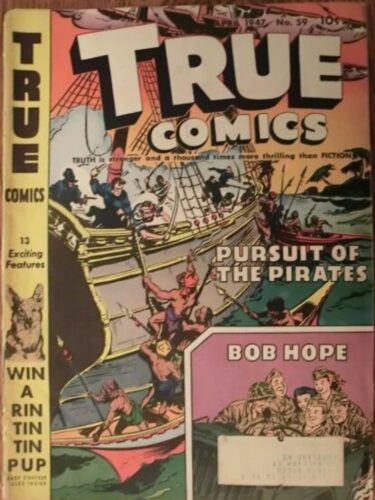
1947 Comic book USA page 1
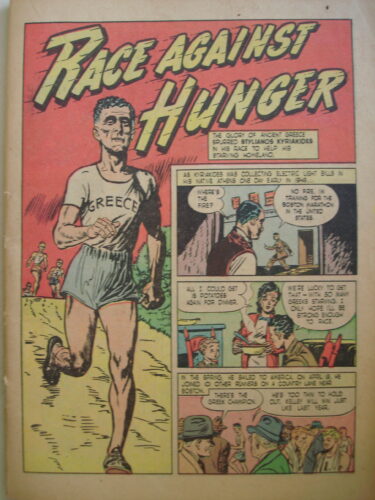
1947 Comic book USA page 2
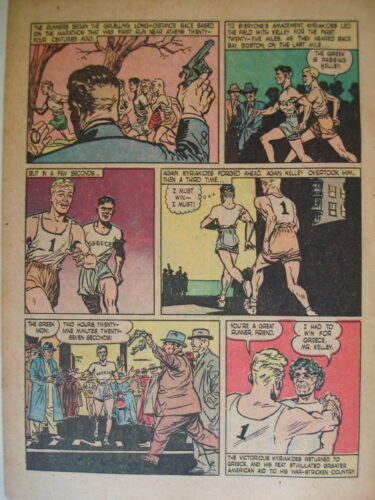
1947 Comic book USA page 3
Boston
In 1946, after the war, he decided to run the Boston Marathon again. To get there, he has to sell part of his furniture, enabling him to buy a single air ticket. The remainder of the ticket money was provided by his employer, the British Electric Supply Company.
In Boston, he runs for charity, for his country. Crossing the finish line in the first place, he shouted “For Greece!”. He begs America for help - and the Americans respond. When he returned to Greece, the American goverment send aid (called the “Kyriakides Aid Package”), which was 25,000 tons of food and supplies, including $250,000 in cash. Over one 600,000 Greeks from all over the country lined the streets of Athens upon his return. He declines offers to stay in the US to become a professional athlete or a movie star, knowing he has to help the rebuilding of his dilapidated country. He sends a message to the Greek people, still fighting a civil war, to forget their differences and unite for the good of the country.
In 1947, he returned to Boston again, this time running for a cause: to collect money and equipment for the Greek track and field team so they could attend the 1948 London Olympics. He returns with $50,000 and clothing and equipment for the Greek team, enabling them to make it to the Olympics the following year.
Aided by the Kyriakides story and accompanying publicity, Greece in 1946/7 was the only country in Europe to receive an advance of $400 million, allocated from the Marshal aid plan (a total of $1.4 billion).
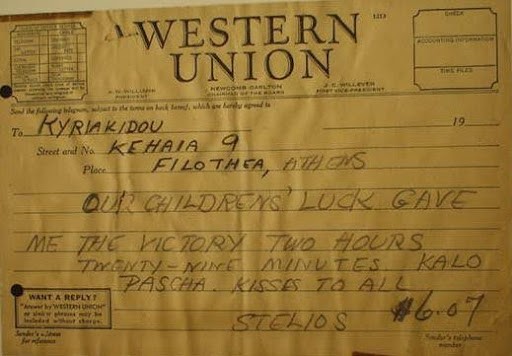
Community and Charity
In 1950 Kyriakides is elected as a member of the Greek Athletic Association (SEGAS) technical committee and started assisting in the rebuilding of the Greek field and track teams. Because of his English, he is the contact of all foreign athletic teams visiting Greece and leads the Greek teams when abroad.
In 1952 he started organizing athletics for the young people, beginning with his own neighborhood of Filothey. From 1954-56, he helped build the Filothey running track and in 1956 started the Filothey Athletic Track and Field Club. In 1972 the track became only the second stadium in Greece to have a ‘tartan’ surface fitted. Although small, under Kyriakides’ guidance, the Filothey club breeds many Greek, Balkan, Mediterranean, and Olympic Champions.
From 1950 to 1980, as a member of the Greek Amateur Association, Kyriakides is responsible for organizing both local and international marathons, which see many of the top runners of the time (from Finland, England, Romania, Turkey, Bulgaria, and Hungary) to come to run. Bekila Abebe, the 1960 and 1964 Olympic champions, ran the race barefooted in 1962, training at the Filothey club in advance to prepare for the race.
Over the next thirty years, Kyriakides was a pillar of the local community, organizing the Boy Scouts in 1957, the Girl Guides in 1958, and many charity events to help collect money for the greater community. When he sees homeless children, he takes them home, and the feds clothe them and help them find their places in the local schools. Although never rich, he spent what little he had on the local athletes, buying food and drinks during any championship events. He organized fundraising dinners/dances, with lottery tickets, to raise money for the community. He used his connections to help those who came to him in need to find work. His whole life, Kyriakides has fought for justice for all, irrespective of background, gender, or race.
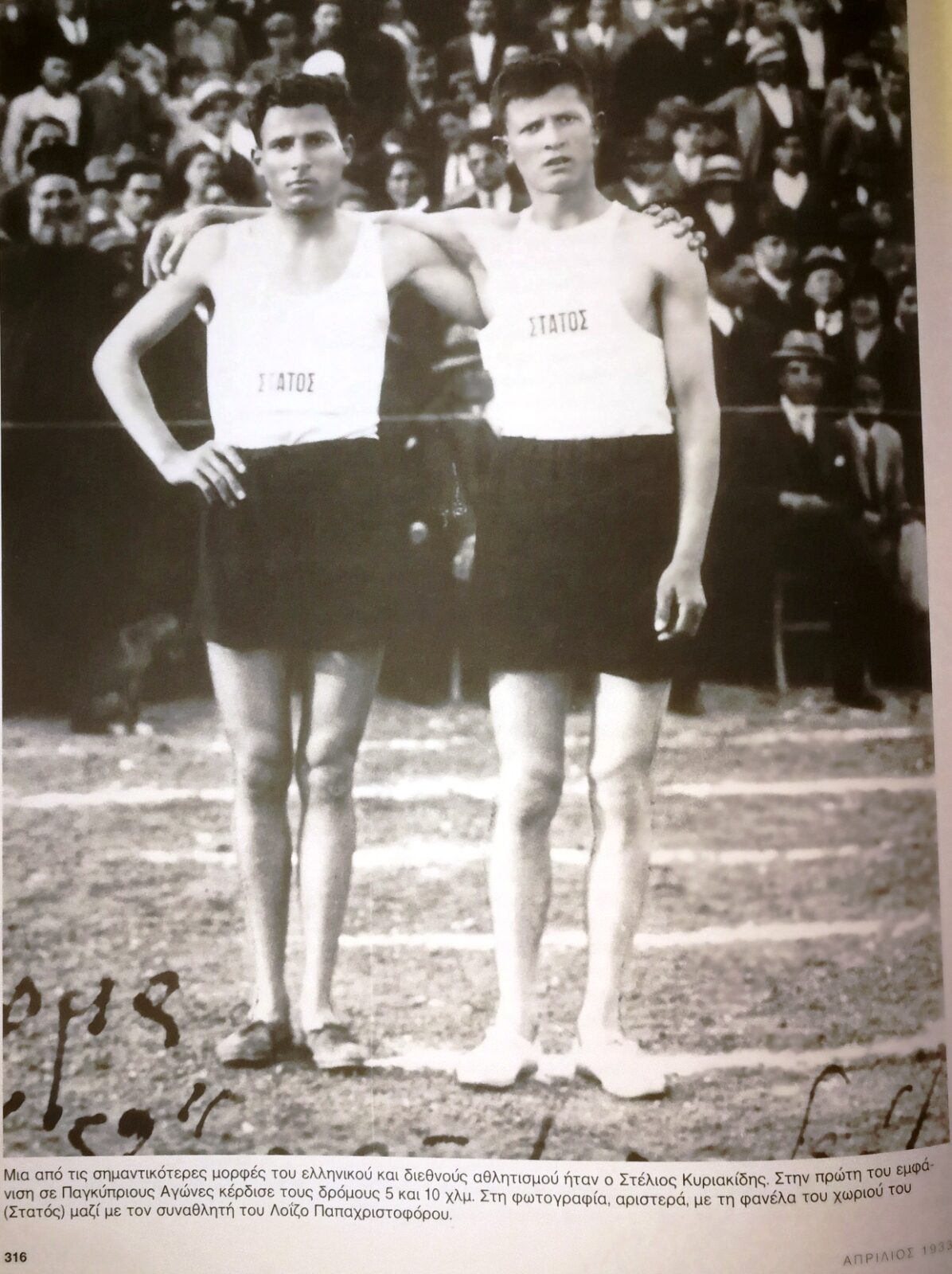
Perseverance and Pioneer
In 1935, Kyriakides becomes the first long distance runner to use a hand stop-watch to pace himself. The next significant long distance runner to do the same is in 1982.
He is among the first to buy books on stretching exercises and also food/ diets/ lifestyle, something unknown for long distance runners of the same era.
He is also one of the first runners to train via long distance correspondence, with his coach Otto Simitchek, in 1934.
To go to Boston in 1946, Kyriakides had to overcome the difficulties of the years of German occupation of Greece and the subsequent civil war. Suffering from malnutrition and very thin, the doctor who examines him before the race refuses to allow him to run, eventually conceding only if Kyriakides is fully responsible for the decision.
Records, Awards and Recognitions
Kyriakides ran the best time in the world in 1946, 2’29’’27, also a European record. He held the Greek national record for over 36 years and 217 days, one of the longest ever according to the Guinness Book of marathon records.
In 1962, Kyriakides received the “Cross of the Golden Phoenix”, the highest civilian award given by the Greek state, for his contribution to the country.
At the Museum of the Marathon (in the city Marathon) the biggest section is the Kyriakides exhibit, which contains not only his athletic medals, diplomas, and victory cups, but also many of his items.
over 15 documentaries have been made of Kyriakides, including the Emmy award-winning in 2004 NBC documentary, “Stylianos Kyriakides, the Journey of a Worrier”. Also included is the 1981 Freddy Germanos documentary, “Front Page”, during which he is awarded a trophy “from 9,000,000 Greeks”. The trophy is now in the Marathon Museum.
Disney is currently making a full-feature film about his 1946 epic (see www.1821media.com).
His biography book, “Running with Pheidippides”, was written and published in the US by Syracuse University, and translated into Greek as “Born a Winner”.
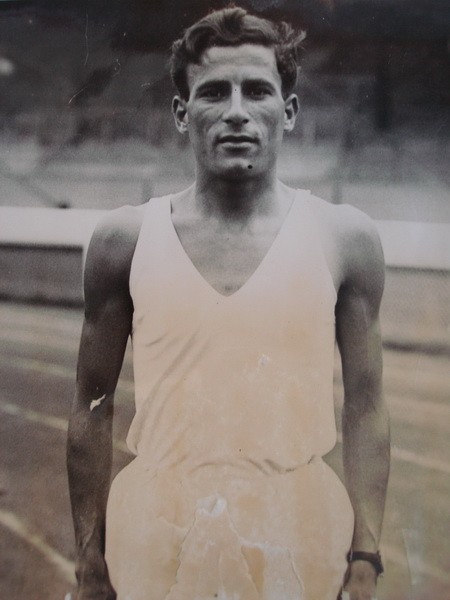
As well as many exhibits around the world about Kyriakides, there are four sculptures in his memory: in Filothei and in the city of Marathon in Greece, at the 1-mile mark of the Boston course; and in his birthplace in Cyprus.
The Filothey stadium that he built between 1954-56 (mainly with donations from fans) is now named after him.
In 1946, Kyriakides was invited to the White House to tell his story about Greece. Moved after hearing the story of the conditions in Greece, the President authorized a special assistance for Greece called the “Kyriakides Aid Package”, which consisted of 25,000 tons of grain, medicine, tinned food, clothing, tents, blankets, and other items. Kyriakides also received cows and bulls from the Masachussetts farmers to take to Greece.
Kyriakides has been - and remains - an inspiration to many long-distance runners, both experienced and also starters. He was a believer in the Olympic ideals of clean amateur sport and fair play. Many Greek marathon runners attend the Boston Marathon to try and get closer to his spirit.
Final
In Boston in 1946, Kyriakides was allocated the No.1 running bib, as an honor. Kyriakides asked instead for the number 77, which he said was a lucky number for the ancient Greeks. When he died in 1987, he was 77 years old. His winning time in 1946 was 2h 29m 27s. So it’s fair to say that the number ‘7’ played a significant part in his life.